

Global Automotive Active Noise Cancellation Sound System Sales Market Advances Toward US$630.69 Million by 2032
Automotive Active Noise Cancellation Sound System Sales Market Report
Automotive Active Noise Cancellation Sound System Market Growth Supported by Rising Demand for Quiet and Comfortable Cabins
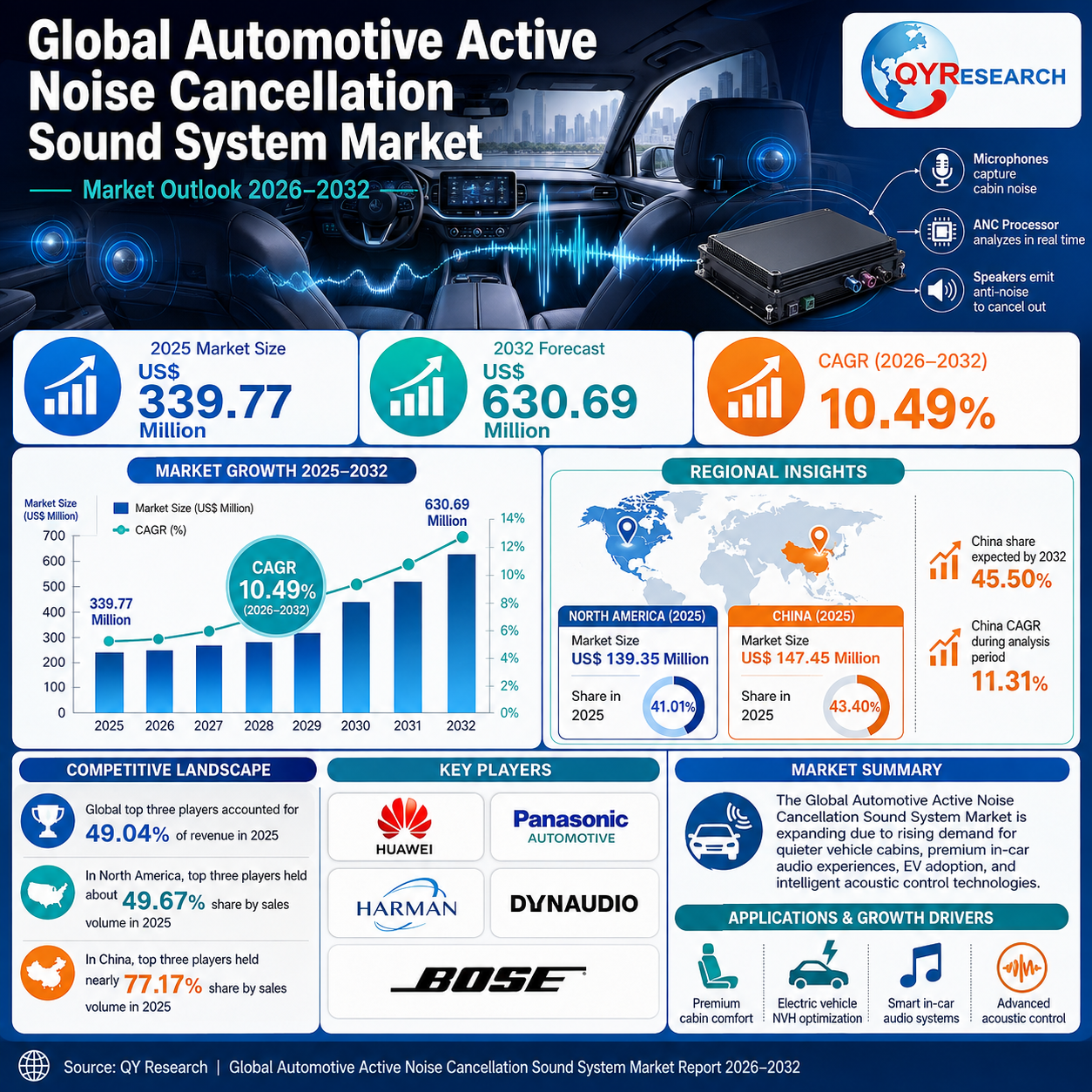
PUNE, MAHARASHTRA, INDIA, August 4, 2026 /EINPresswire.com/ -- PUNE, INDIA, August 3, 2026 — A new analysis of the Global Automotive Active Noise Cancellation Sound System Market, Competitive Analysis and Regional Opportunities 2026–2032 indicates that active acoustic management is becoming an increasingly important component of next-generation vehicle design. The worldwide market, valued at US$339.77 million in 2025, is forecast to reach US$630.69 million by 2032, advancing at a compound annual growth rate of 10.49% throughout the forecast period.The findings present an expanding commercial landscape for automotive audio suppliers, vehicle manufacturers, component developers, investors, research organizations, acoustic engineers, and mobility-technology companies. As vehicle interiors evolve into connected, software-enabled environments, active noise cancellation is moving beyond its traditional role as a premium comfort feature. It is increasingly being evaluated as part of a broader vehicle sound-management strategy involving road-noise reduction, powertrain acoustic control, personalized audio zones, voice-recognition performance, and branded in-cabin experiences.
For manufacturers, suppliers, and research institutions operating in Pune, India, the forecast provides a timely perspective on opportunities involving automotive electronics, embedded software, microphones, accelerometers, amplifiers, speakers, digital signal processors, acoustic calibration, and vehicle-system integration. Local engineering organizations and component suppliers may benefit as automotive original equipment manufacturers seek regional development support, shorter supply chains, specialized testing capabilities, and market-specific acoustic tuning.
Download Exclusive Research Report PDF Sample: (Including Full TOC, List of Tables & Figures, Chart) @ https://www.qyresearch.in/request-sample/automobile-transportation-global-automotive-active-noise-cancellation-sound-system-sales-market-report-competitive-analysis-and-regional-opportunities-2026-2032
Market Overview
The Automotive Active Noise Cancellation Sound System market covers integrated hardware and software solutions that identify unwanted sound inside a vehicle and generate controlled opposing sound waves through the cabin’s audio architecture. Depending on the vehicle platform, these systems may use microphones, vibration sensors, accelerometers, control units, speakers, amplifiers, and signal-processing algorithms to reduce targeted engine, road, tire, chassis, or environmental noise.
Based on the forecast, the market is expected to add approximately US$290.92 million in annual value between 2025 and 2032. The projected increase reflects not only higher vehicle production and sales but also a greater installation rate across premium, mid-range, electric, hybrid, and technology-focused passenger vehicles.
The market’s development is closely connected with the transformation of vehicle interiors. Automakers are positioning the cabin as a central point of product differentiation, particularly as infotainment, connectivity, voice interaction, entertainment, driver assistance, and passenger personalization become more prominent. Active noise cancellation can support that strategy by helping vehicle designers manage the sound environment without relying exclusively on heavier passive insulation materials.
Market Key Drivers
The expansion of electric and new-energy vehicles is expected to remain one of the most influential market drivers through 2032. Electric powertrains remove or reduce conventional engine sound, but this can make tire, road, suspension, airflow, and chassis noise more noticeable to vehicle occupants. Consequently, manufacturers are placing greater attention on broadband road-noise cancellation and integrated cabin-acoustic control.
Consumer expectations are also changing. Buyers increasingly evaluate a vehicle according to the total cabin experience rather than traditional performance specifications alone. Quietness, audio clarity, conversation comfort, personalized entertainment, and voice-assistant accuracy are becoming visible indicators of vehicle quality. This creates opportunities for active noise cancellation systems that can operate together with premium sound systems and intelligent cockpit platforms.
Vehicle-weight optimization represents another important driver. Passive sound insulation can require additional material, packaging space, and weight. Active technologies cannot eliminate every need for physical insulation, but they can complement conventional noise, vibration, and harshness engineering. This combination may help manufacturers pursue cabin-comfort objectives while managing energy efficiency, range, material consumption, and platform weight.
Additional momentum is expected from faster digital signal processing, more capable automotive computing platforms, improved cabin sensors, enhanced audio amplifiers, and software-based calibration. These advances may enable systems to respond more accurately to changing road surfaces, passenger positions, vehicle speeds, tire conditions, and cabin configurations.
Regional Insights
China represented the largest individual market identified in the analysis, reaching US$147.45 million in 2025, equivalent to 43.40% of global revenue. Its share is projected to increase to 45.50% by 2032, supported by an estimated regional CAGR of 11.31%. At the projected global market value, a 45.50% share would place China’s 2032 market opportunity at approximately US$286.96 million.
China’s position is reinforced by its extensive electric-vehicle manufacturing ecosystem, rapid model-development cycles, strong domestic technology sector, and growing integration of advanced cockpit functions. The region may offer substantial opportunities for suppliers capable of delivering scalable software, localized engineering, competitive hardware platforms, and close cooperation with vehicle manufacturers.
North America generated approximately US$139.35 million in 2025, accounting for 41.01% of the global market. The region remains significant due to its established premium-vehicle market, large passenger-vehicle base, strong automotive audio brands, and continued demand for comfort technologies in sport utility vehicles, pickups, electric vehicles, and luxury models.
Europe is expected to remain an important innovation and application region, particularly through premium vehicle engineering, electrification, sustainability objectives, and advanced noise, vibration, and harshness development. Japan and South Korea also represent strategically relevant markets because of their automotive manufacturing capabilities, electronics expertise, established audio suppliers, and participation in electric and connected vehicle programs.
Regional performance will depend on vehicle-production conditions, consumer purchasing power, electrification rates, supplier localization, technology costs, trade policies, and the pace at which active acoustic systems move from luxury vehicles into higher-volume categories.
Market Segmentation
By system type, the market is divided into Engine Harmonic Cancellation, Road Noise Cancellation, and Other Active Sound Management Solutions.
Engine Harmonic Cancellation systems focus on repetitive frequencies produced by internal-combustion engines, hybrid powertrains, cylinder-deactivation technologies, and related mechanical sources. This segment is expected to remain commercially relevant because fuel-powered and hybrid vehicles will continue to represent a substantial part of the global fleet during the forecast period.
Road Noise Cancellation is positioned for strong long-term attention as vehicle electrification makes road, tire, suspension, and structural noise more perceptible. These systems typically require broader-frequency processing and coordination among sensors, microphones, controllers, amplifiers, and speakers. Continued improvements in processing speed and acoustic modeling could expand their use across multiple vehicle price categories.
The “Others” category includes emerging sound-control functions such as localized acoustic zones, seat-based noise management, active sound enhancement, environmental noise control, and integrated cabin-experience applications.
By application, the market is segmented into New Energy Vehicles and Fuel Vehicles. New-energy vehicles are expected to provide a strong incremental opportunity because quiet electric drivetrains place greater emphasis on remaining cabin noise. Fuel vehicles, however, continue to create demand for engine harmonic cancellation, cylinder-order control, road-noise management, and premium audio integration.
Competitive Landscape
The competitive environment includes Huawei, Panasonic Automotive, Harman, Dynaudio, Bose, and other specialized automotive audio, electronics, acoustic-software, and component providers. In 2025, the three largest global participants accounted for approximately 49.04% of market revenue, indicating a moderately concentrated international market with meaningful barriers related to acoustic expertise, automotive qualification, intellectual property, vehicle integration, and long-term original-equipment-manufacturer relationships.
Concentration varies considerably by region. In North America, the three leading suppliers represented approximately 49.67% of 2025 sales volume. In China, the three largest participants controlled nearly 77.17%, indicating a more concentrated competitive structure.
Competitive advantage is expected to depend on more than speaker performance. Suppliers must increasingly combine acoustic algorithms, sensor integration, embedded processing, vehicle-network compatibility, power efficiency, cybersecurity considerations, calibration tools, and production-scale engineering. Companies that can integrate active noise cancellation with infotainment, voice control, premium audio, and centralized cockpit computing may be positioned to capture higher-value contracts.
The forecast period may also encourage partnerships among automakers, semiconductor companies, audio brands, Tier One suppliers, software developers, microphone manufacturers, and acoustic-testing specialists. Such partnerships can reduce development time and enable active noise control to be adapted across shared vehicle platforms.
Market Trends and Dynamics
A major trend is the transition from isolated noise-cancellation functions to comprehensive sound-management platforms. Future systems are likely to coordinate noise suppression, sound enhancement, entertainment audio, warning sounds, communication, and occupant-specific sound zones through a unified architecture.
Software-defined functionality may further reshape the market. Once the necessary microphones, speakers, sensors, and processing resources are installed, manufacturers could improve acoustic performance through software updates, revised algorithms, or model-specific tuning. This creates potential for longer product lifecycles, post-production improvements, feature packages, and recurring software value.
Personalization is another developing theme. Instead of providing one acoustic environment for the entire cabin, advanced systems may adapt sound according to seat position, passenger preference, driving mode, road condition, or entertainment activity. This could be especially valuable in large vehicles, premium models, autonomous-mobility concepts, and vehicles designed as mobile work or entertainment spaces.
Challenges remain, including development cost, vehicle-specific calibration, algorithm latency, component reliability, microphone placement, changing cabin loads, road variability, and potential interference with entertainment or safety-related sounds. Suppliers must also demonstrate consistent performance across different trim levels, tires, suspension systems, body structures, and production tolerances.
Despite these challenges, the 2026–2032 outlook remains favorable. Market growth is expected to be supported by electrification, premiumization, intelligent cockpit adoption, improved processing technology, and greater recognition of acoustic comfort as a measurable element of vehicle quality.
Industry Outlook
For investors, the market offers exposure to the convergence of automotive electronics, audio engineering, embedded software, sensors, and intelligent mobility. Researchers may find opportunities in adaptive algorithms, machine learning, virtual acoustic development, lightweight noise management, and occupant-specific sound control. Manufacturers can use the forecast to assess product-development priorities, regional partnerships, supply-chain requirements, and potential entry points across vehicle platforms.
The projected rise to US$630.69 million by 2032 signals a market that is becoming increasingly strategic to the automotive cabin experience. Companies that combine reliable hardware, scalable software, regional engineering support, and strong relationships with automakers are expected to be well positioned as active noise cancellation progresses from a specialized premium feature toward wider automotive adoption.
Key Questions Addressed by the Market Analysis
(1) How large will the Automotive Active Noise Cancellation Sound System market become?
(2) Which region offers the largest opportunity?
(3) What technologies are included in the market?
(4) Which vehicle category is expected to create significant demand?
(5) Who are the leading market participants?
(6) What should investors and manufacturers monitor through 2032?
For Further insights and Detailed Reports, Visit: https://www.qyresearch.in/report-details/2963048/Global-Automotive-Active-Noise-Cancellation-Sound-System-Sales-Market
About QYResearch
QYResearch founded in California, USA in 2007.It is a leading global market research and consulting company. With over 19 years’ experience and professional research team in various cities over the world QY Research focuses on management consulting, database and seminar services, IPO consulting (data is widely cited in prospectuses, annual reports and presentations), industry chain research and customized research to help our clients in providing non-linear revenue model and make them successful. We are globally recognized for our expansive portfolio of services, good corporate citizenship, and our strong commitment to sustainability. Up to now, we have cooperated with more than 60,000 clients across five continents. Let’s work closely with you and build a bold and better future.
Contact US
Ankit Jain - Director, Global Digital Marketing
QY Research, INC.
India Office -
315Work Avenue, Raheja Woods, Kalyani Nagar,
Pune, Maharashtra 411006, India
Web – https://www.qyresearch.in
Email- ankit@qyresearch.com
Ankit Jain
QY Research India
+ +91 8149736330
ankit@qyresearch.com
Legal Disclaimer:
EIN Presswire provides this news content "as is" without warranty of any kind. We do not accept any responsibility or liability for the accuracy, content, images, videos, licenses, completeness, legality, or reliability of the information contained in this article. If you have any complaints or copyright issues related to this article, kindly contact the author above.
