

Beekeeping Equipment Market to Reach US$ 2.99 Billion by 2035, Growing at a 4.56% CAGR Amid Rising Honey Demand
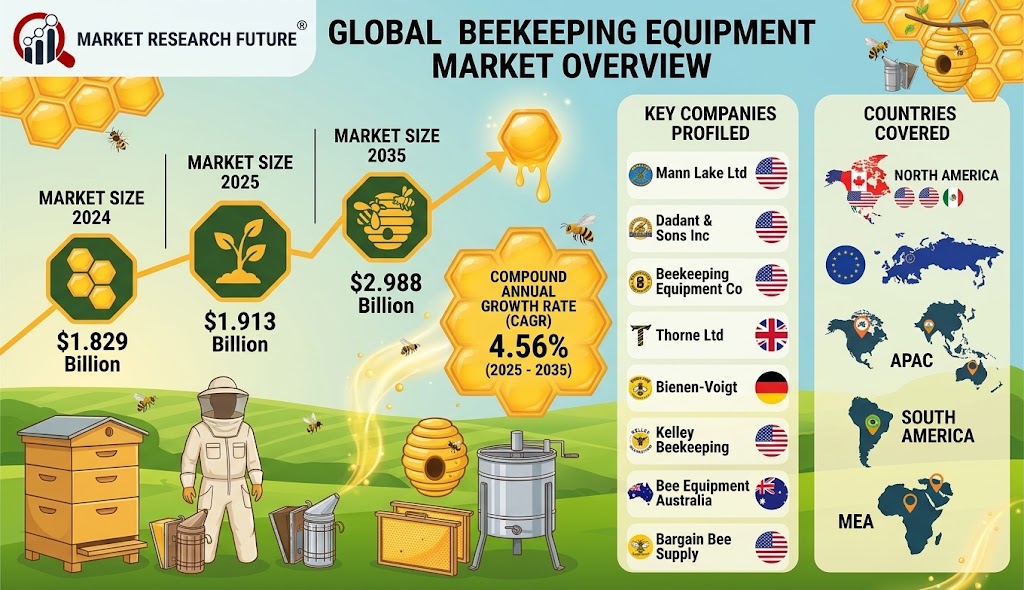
Beekeeping Equipment Market is projected to increase from US$ 1.913 billion in 2025 to US$ 2.988 billion by 2035, registering a CAGR of 4.56% from 2025 to 2035.
NEW YORK, NY, UNITED STATES, August 23, 2026 /EINPresswire.com/ -- The global Beekeeping Equipment Market is experiencing steady expansion as beekeeping gains importance across commercial agriculture, sustainable farming, pollination services, and hobby-based activities. The market is being shaped by increasing awareness of the ecological and economic importance of bees, rising demand for honey and bee-related products, technological innovation, and supportive government policies.The growing participation of both professional and amateur beekeepers is creating sustained demand for specialized equipment. Beekeepers require products ranging from beehives and protective clothing to honey extractors, smokers, and hive tools. At the same time, technological development is introducing more efficient solutions for hive management and honey extraction. These changes are broadening the customer base and enabling equipment manufacturers to serve both traditional and modern beekeeping operations.
The market is also benefiting from increasing awareness of pollinators and their role in agricultural ecosystems. As more individuals and organizations recognize the ecological benefits of maintaining bee populations, beekeeping is becoming an increasingly attractive activity. Educational programs, workshops, online courses, and community initiatives are further encouraging participation and improving awareness of equipment usage and beekeeping practices.
Request for Free Sample of Report: https://www.marketresearchfuture.com/sample_request/29379
Market Trends:
1. Sustainable Beekeeping Practices
Sustainability is becoming one of the most important trends influencing the Beekeeping Equipment Market. Consumers and beekeepers are showing greater interest in equipment manufactured using eco-friendly materials and sustainable production practices. This changing preference is encouraging manufacturers to innovate and develop products that align with broader environmental stewardship objectives.
The shift toward sustainable equipment also reflects the growing awareness of the importance of bees within ecosystems. As beekeepers become more conscious of environmental considerations, manufacturers are expected to continue introducing products that combine functionality with sustainable materials and production approaches.
2. Technological Advancements
Technology is transforming traditional beekeeping activities by improving hive management and honey extraction. New tools and devices are making equipment more efficient and user-friendly, which can also make beekeeping more accessible to new participants.
Smart technologies, including IoT devices and automated hive monitoring systems, are increasingly relevant to the industry. These technologies allow beekeepers to monitor hive conditions in real time and make more informed management decisions. Technological innovation is therefore creating opportunities for equipment manufacturers to differentiate their products through improved functionality and efficiency.
3. Educational Initiatives
Education is another important market trend. Workshops, online courses, and community programs are increasingly being used to inform potential beekeepers about best practices and appropriate equipment usage. Such initiatives can create a more knowledgeable base of beekeepers and encourage additional participation in the industry.
Educational activities are particularly relevant to hobby beekeeping, where individuals may require greater access to information before establishing and maintaining their own hives. As awareness and knowledge increase, demand for specialized equipment is expected to benefit.
Market Drivers:
1. Increasing Urban Beekeeping
The growth of urban beekeeping is a significant factor supporting equipment demand. As people in urban areas seek sustainable activities, beekeeping provides an opportunity to participate in environmental and agricultural practices even within limited spaces. Cities implementing regulations that support hive installations can further encourage participation.
Urban beekeeping also creates a specific requirement for equipment suited to smaller-scale operations and restricted environments. This provides manufacturers with an opportunity to develop innovative products tailored to urban users. The expansion of urban beekeeping consequently supports both the broader market and the development of specialized equipment solutions.
2. Supportive Government Policies
Government initiatives supporting sustainable agriculture and environmental conservation are positively influencing the market. According to MRFR, various countries have introduced policies involving financial assistance and subsidies for beekeepers, while programs supporting beekeeping education and equipment purchases can encourage the adoption of modern practices.
Such support can increase participation in beekeeping while helping existing operators upgrade their equipment. A supportive policy environment therefore contributes to market development by strengthening the underlying beekeeping industry and increasing the need for specialized equipment.
3. Rising Demand for Honey Products
Increasing consumer preference for natural and organic products is supporting demand for honey. As honey consumption rises, beekeepers require effective equipment to improve production efficiency and maintain product quality.
The relationship between honey demand and equipment demand is particularly important for commercial beekeepers. Higher production requirements can encourage investment in equipment that supports hive management, honey extraction, and related operations. This makes rising demand for honey products an important contributor to market expansion.
4. Technological Innovation in Beekeeping
Technological innovation is another major market driver. Smart hive technologies, automated monitoring systems, and improved extraction equipment can help beekeepers monitor conditions and manage operations more effectively.
The introduction of technology can also attract new participants who prefer modern and user-friendly solutions. As technology becomes increasingly integrated into beekeeping practices, manufacturers that focus on innovation can address changing customer requirements and contribute to the expansion of the overall equipment market.
5. Growing Awareness of Pollinator Importance
Growing recognition of bees as essential pollinators is strengthening interest in beekeeping. Educational campaigns and initiatives emphasizing the role of bees in food production and biodiversity are encouraging more people to participate in beekeeping.
This increased awareness creates a broader foundation for market growth because new and existing beekeepers require appropriate equipment to maintain bee populations and manage hives. Consequently, pollinator awareness is supporting the industry's transition toward greater participation and sustainability.
Market Opportunities:
Expansion of Urban Beekeeping - Urban beekeeping offers an important opportunity for equipment manufacturers. The increasing participation of people in cities creates demand for products designed specifically for smaller spaces and simplified management. Companies can address this opportunity by developing equipment that is practical, accessible, and suitable for urban environments.
Smart Hive Monitoring - The integration of smart technology represents a significant future opportunity. MRFR identifies the development of smart hive monitoring systems for real-time data analysis as an important opportunity. Such systems can help beekeepers monitor hive conditions and improve management efficiency. Technology-focused products can also create new value propositions beyond traditional equipment. By combining monitoring capabilities with established hive management solutions, manufacturers can target technologically oriented commercial and hobby beekeepers.
Eco-Friendly Solutions - The increasing preference for sustainable practices creates opportunities for manufacturers to develop environmentally responsible equipment. Eco-friendly materials and sustainable manufacturing processes can help companies respond to changing consumer preferences while strengthening their market positioning.
Subscription-Based Supply Services - Subscription-based delivery of beekeeping supplies is another opportunity identified in the market outlook. Such services can provide beekeepers with regular access to essential supplies while creating a recurring business model for equipment suppliers.
Honey Product Packaging Solutions - The market's future opportunities also extend to eco-friendly packaging solutions for honey products. Such offerings can complement equipment-related businesses and enable market participants to address broader sustainability requirements associated with beekeeping and honey production.
Segmental Analysis:
1. Equipment Type
The equipment type segment includes Beehives, Protective Clothing, Honey Extractors, Smokers, and Hive Tools. Beehives represent the largest segment, as they are fundamental to establishing and maintaining bee colonies and supporting honey production.
Honey Extractors, meanwhile, are identified as the fastest-growing segment. Their growth is associated with increasing demand for efficient honey processing equipment in commercial and home beekeeping applications. Technological developments are also making honey extraction equipment more accessible, supporting adoption among both hobbyists and professional operators.
2. Beekeeping Practices
The market is divided into Commercial Beekeeping, Hobby Beekeeping, and Pollination Services. Commercial Beekeeping represents the largest segment, reflecting the scale of professional operations and their emphasis on productivity and efficiency.
Hobby Beekeeping is the fastest-growing segment. The growing popularity of urban farming and sustainable activities is encouraging more individuals to establish and manage hives. Educational resources and community support are also helping hobby beekeepers gain the knowledge required to operate effectively.
Pollination Services form another important component of the market because agricultural activities rely on bee activity to support crop yields. Growing emphasis on pollination and crop improvement contributes to equipment demand within this segment.
3. Bee Species
The market covers European Honey Bee, Africanized Honey Bee, and Asian Honey Bee. The European Honey Bee represents the largest segment because of its widespread use for honey production and pollination. Its relatively gentle nature, high honey yield, adaptability, and ease of management make it an important species for both commercial and hobby beekeepers.
The Africanized Honey Bee is identified as the fastest-growing segment. Its resilience and ability to thrive in challenging environments make it relevant to certain beekeeping applications, although its aggressive characteristics create different management requirements.
4. Product Material
The product material segment consists of Wood, Plastic, Metal, Rubber, and Textiles. Wood remains the largest material category because of its traditional use in hive construction, durability, natural insulation properties, and familiarity among beekeepers.
Plastic is the fastest-growing material segment. Its lightweight characteristics, resistance to rot, ease of cleaning, and ability to withstand different environmental conditions are increasing its appeal. The growing interest in modern equipment and alternative materials is supporting plastic adoption.
5. Distribution Channel
The distribution channel segment comprises Online Retailers, Farm Supply Stores, Specialty Beekeeping Suppliers, Hardware Stores, and Direct Sales.
Online Retailers represent the largest distribution channel, benefiting from convenience and broad product availability. Online purchasing provides beekeepers with easier access to a wide variety of equipment.
Specialty Beekeeping Suppliers are the fastest-growing channel. These suppliers attract customers seeking specialized products, quality equipment, and expert guidance. The coexistence of online and specialist channels reflects the changing purchasing preferences of the beekeeping community.
Regional Analysis:
1. North America
North America is the largest regional market, accounting for approximately 45% of the global market share. The region benefits from strong consumer demand for honey and bee-related products, increasing awareness of pollinators, regulatory support, favorable climatic conditions, and established agricultural practices.
The United States represents the leading country in the region, with companies such as Mann Lake Ltd and Dadant & Sons Inc contributing to the competitive landscape. Canada also plays an important role, particularly through its focus on sustainable beekeeping practices. The presence of established companies and strong distribution networks supports continued innovation and product accessibility.
2. Europe
Europe holds approximately 30% of the global market share and represents another significant market. Increasing environmental awareness and the region's emphasis on biodiversity are encouraging beekeeping as a sustainable practice.
Germany and the United Kingdom are identified as leading countries, with companies including Bienen-Voigt and Thorne Ltd contributing to the market. The regional competitive environment combines traditional beekeeping practices with modern sustainability-focused approaches, while growing interest in local and organic honey supports demand for advanced equipment.
3. Asia-Pacific
Asia-Pacific represents approximately 20% of the global market share and is emerging as a rapidly growing region. Increasing agricultural activity, rising demand for honey and bee products, and government policies promoting beekeeping are supporting regional development.
China is identified as the largest market in the region, followed by Australia. The region's diverse climate supports varied beekeeping practices, while growing awareness of the ecological benefits of beekeeping is expected to strengthen demand for quality equipment.
4. Middle East and Africa
The Middle East and Africa region accounts for approximately 5% of the global market share and represents an emerging market with significant potential. Growing awareness of the importance of bees for agriculture and food security is encouraging beekeeping activities.
South Africa is identified as the largest market in the region, while Kenya is also making progress through initiatives promoting beekeeping as a livelihood. As the regional market matures, demand for quality equipment is expected to increase.
Competitive Landscape and Company Profiles:
The Beekeeping Equipment Market has a moderately fragmented competitive structure, with established companies competing alongside emerging participants. Competition is increasingly focused on innovation, sustainability, product quality, distribution capabilities, and supply-chain reliability rather than price alone.
Mann Lake Ltd is one of the prominent companies in the market and is identified among the key players. The company is positioned within a competitive environment increasingly focused on sustainable products and technological innovation.
Dadant & Sons Inc is another major market participant. Its presence contributes to the competitive structure of the North American market and its wider international expansion activities.
Beekeeping Equipment Co is included among the key companies operating in the market, contributing to the availability of specialized equipment for beekeeping applications.
Thorne Ltd is a major United Kingdom-based participant identified in the market. The company contributes to the European competitive environment, where traditional practices increasingly intersect with digitalization and sustainability.
Bienen-Voigt is a key German participant and contributes to Europe's established beekeeping equipment industry.
Kelley Beekeeping, Bee Equipment Australia, and Bargain Bee Supply are also identified among the key companies profiled in the market. Collectively, these companies contribute to a competitive environment characterized by product innovation, specialized supply, sustainability, and improving access to beekeeping equipment.
Recent Developments:
August 2025: Mann Lake Ltd announced the launch of a new line of sustainable beekeeping equipment made from recycled materials. The development reflects the increasing importance of environmentally friendly products and supports the company's positioning around sustainability.
September 2025: Dadant & Sons Inc expanded its distribution network by partnering with local suppliers in Europe. The initiative was aimed at improving European market penetration, delivery times, and customer service.
July 2025: Thorne Ltd launched an innovative digital platform designed to provide beekeepers with real-time data analytics related to hive health and productivity. The development demonstrates the growing role of digital technologies in traditional beekeeping practices.
October 2025: Competitive trends in the Beekeeping Equipment Market increasingly reflected digitalization, sustainability, and the integration of artificial intelligence. Strategic alliances among key companies were also shaping innovation and collaboration across the industry.
Conclusion:
The global Beekeeping Equipment Market is positioned for consistent growth throughout the forecast period as demand for honey products, sustainable agricultural practices, pollinator awareness, and advanced beekeeping technologies continues to increase. The market is projected to expand from USD 1.913 billion in 2025 to USD 2.988 billion by 2035, representing a 4.56% CAGR during 2025–2035.
The industry's development is being supported by the expansion of urban beekeeping, government support, technological innovation, and growing participation among hobbyists and professional beekeepers. Beehives remain the dominant equipment category, while honey extractors represent the fastest-growing equipment segment. Commercial beekeeping leads by practice, while hobby beekeeping is expanding rapidly. European Honey Bees remain the dominant species, wood continues to lead by material, and online retailers hold the leading position among distribution channels.
As beekeeping continues evolving from a traditional agricultural activity toward a more technology-enabled and sustainability-oriented practice, equipment manufacturers are likely to focus increasingly on efficiency, accessibility, environmental responsibility, and digital capabilities. The combination of these factors supports a positive outlook for the global Beekeeping Equipment Market through 2035.
Browse More Reports:
Apiculture Market
https://www.marketresearchfuture.com/reports/apiculture-market-41406
Protective Gloves Market
https://www.marketresearchfuture.com/reports/protective-gloves-market-11995
Agricultural Disinfectants Market
https://www.marketresearchfuture.com/reports/agricultural-disinfectants-market-5252
Sagar Kadam
Market Research Future
+1 628-258-0071
sales@marketresearchfuture.com
Legal Disclaimer:
EIN Presswire provides this news content "as is" without warranty of any kind. We do not accept any responsibility or liability for the accuracy, content, images, videos, licenses, completeness, legality, or reliability of the information contained in this article. If you have any complaints or copyright issues related to this article, kindly contact the author above.
